
AI companions
Enterprise AI is moving toward persistent assistants that collaborate with employees across systems and workflows.
A decision-focused guide to AI companions, agentic workflows, hybrid intelligence, enterprise productivity, skills, jobs, security and workforce redesign as AI moves deeper into business operations.
The 2026 programme connects AI companions, agentic systems, enterprise optimisation and hybrid intelligence. The commercial opportunity lies in redesigning work so people, data, software and autonomous systems operate with clearer roles, measurable outcomes and appropriate controls.

Enterprise AI is moving toward persistent assistants that collaborate with employees across systems and workflows.
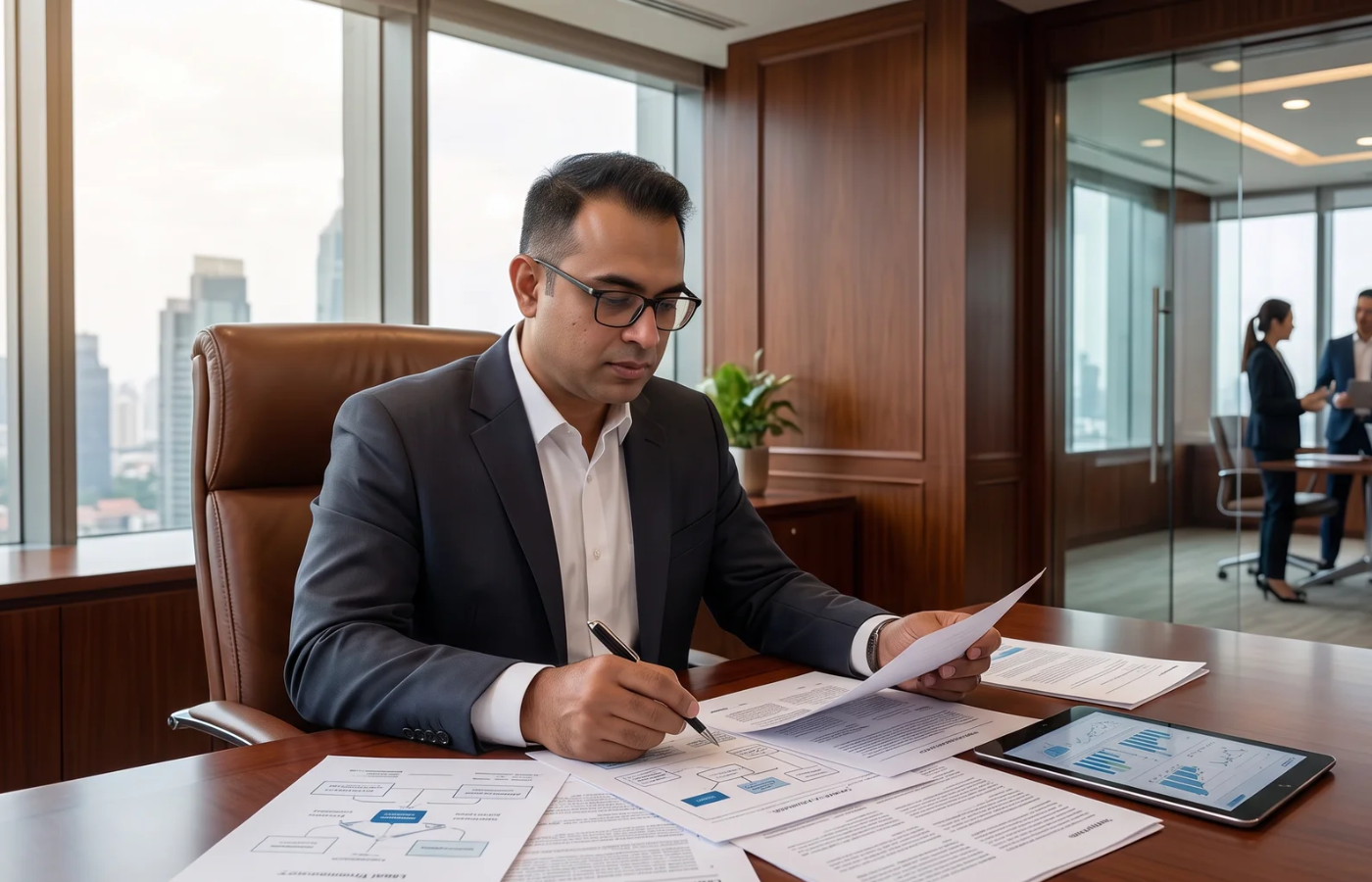
Autonomous execution can change process economics, but only when permissions, exceptions and accountability are explicit.
The Mainstage frames future-ready work around combining human expertise with autonomous systems rather than treating them as substitutes.
Use the programme evidence to test infrastructure requirements, supplier claims, economics and execution risk.
Identify infrastructure bottlenecks that can become defensible products, services or integration opportunities.
Separate structural demand from vendor narratives by testing deployment constraints, standards and unit economics.
Translate infrastructure themes into procurement requirements, technical diligence and deployment sequencing.
Direct answer: The future-of-work signal at Tech Week Singapore 2026 is not simply that AI will automate more tasks. The official programme is structured around AI companions, agentic systems, workflow redesign, enterprise productivity, human-AI collaboration and the wider effect of advanced AI on organisations and jobs. The practical issue for leaders is how work should be redesigned when software can plan, generate, analyse, coordinate and increasingly execute bounded actions.
Cloud & AI Infrastructure Asia's Enterprise Optimisation Theatre explicitly explores AI companions and agentic systems that collaborate with employees, automate workflows and redesign business processes. The Mainstage adds Hybrid Intelligence, defined around integrating human expertise with autonomous systems to support a future-ready workforce and more resilient society.
This framing is useful because task automation and job elimination are not the same analytical unit. A role contains many tasks with different levels of judgment, context, accountability, physical presence and social interaction. AI may remove some steps, compress others, create new review work and increase the value of human judgment at specific control points.
Most enterprises already have productivity software. The next question is whether AI changes the sequence of work itself. Agentic systems can potentially collect information, draft outputs, trigger tools, monitor conditions and route exceptions. That creates opportunities to redesign handoffs, reduce waiting time and standardise repeatable decisions.
However, measurable ROI depends on process quality. Automating a poorly defined workflow can accelerate errors. Leaders should first map the objective, input data, decision rights, exception cases, approval thresholds and evidence requirements. Only then can AI be assigned to steps where it has the necessary context and bounded authority.
The official theatre description highlights AI companions that work with employees rather than merely respond to isolated prompts. This has major implications for interface design. Instead of users navigating multiple applications, an AI layer may increasingly coordinate searches, documents, analytics, tickets, communications and workflow actions.
That can improve usability, but it can also obscure system boundaries. Organisations need clear provenance, permissions, audit trails and escalation logic so that employees know what the system did, what information it used and which actions require human confirmation.
When software can execute actions, managers must define policy boundaries in machine-operable form. Approval thresholds, budget limits, data-access rules, customer-communication standards and exception handling can no longer exist only as informal knowledge. This pushes organisations toward more explicit operating models.
Managers may therefore spend less time supervising routine execution and more time defining objectives, reviewing exceptions, designing controls and improving systems. That is a structural shift in management work, but the pace will vary greatly by industry, risk level and process maturity.
Generic calls for everyone to learn AI are too broad to guide workforce planning. Different roles need different capabilities. Executives need enough understanding to allocate risk and capital. Managers need workflow and control design. Technical teams need model, data, platform and security skills. Domain experts need to translate tacit knowledge into rules, examples and evaluation criteria. Front-line employees need the ability to supervise tools, recognise failure modes and escalate correctly.
The 2026 programme also includes human-centred innovation at scale and workplace-oriented platform design. Those themes suggest that adoption depends on cognitive load, onboarding and usability, not only model capability.
Useful metrics include cycle time, rework, error rates, throughput, service quality, escalation rate, employee time saved and incremental revenue. Headcount reduction is only one possible outcome and often a poor first metric because AI may instead allow the same team to process more work or deliver a higher-quality service.
For founders selling workplace AI, the strongest evidence is usually a before-and-after workflow with measurable economics. For buyers, proof should include implementation effort, data dependencies, control requirements and the cost of human review.
Cyber Security World Asia explicitly covers workplace culture and cybersecurity, while AI and agentic systems increase the number of non-human actors that can access enterprise data and tools. Workforce transformation therefore needs identity, least privilege, device security, data classification and monitoring alongside productivity design.
An employee with an AI companion may effectively operate through several service identities and integrations. Organisations should understand which credentials are used, what each agent can access, how actions are logged and how permissions are revoked when roles change.
| Opportunity | Enterprise question | Commercial signal |
|---|---|---|
| AI companions | Which information and actions should be available through one conversational layer? | Demand for secure enterprise assistants, search, orchestration and integration |
| Agentic workflows | Which bounded processes can execute with exception-based human review? | Workflow automation, agent platforms, policy and monitoring tools |
| Human-AI collaboration | Where does human judgment add the most value? | Evaluation, review, training and decision-support products |
| Workforce enablement | What role-specific skills and operating procedures are required? | Training, change management and workflow-design services |
| Trust and security | How are permissions, provenance, auditability and escalation handled? | Identity, security, governance and compliance infrastructure |
| ROI | Which workflow metrics improve after deployment? | Tools that produce measurable cycle-time, quality or revenue gains |
Founders should avoid positioning AI only as a generic productivity layer. Products become more defensible when they own a high-value workflow, integrate with systems of record, capture evaluation feedback and demonstrate measurable improvement. Investors should examine whether a product changes durable process economics or simply adds a thin interface over widely available models.
Employers should prioritise jobs and processes where AI can be tested safely, outcomes are measurable and domain experts can supervise adoption. They should also identify tasks that depend on trust, accountability, negotiation, physical execution, contextual judgment or regulated sign-off, because these may remain human-led even as surrounding work becomes more automated.
Future of work Singapore 2026, Tech Week Singapore future of work, AI jobs Singapore, AI workforce Asia, human AI collaboration, hybrid intelligence, AI companions enterprise, agentic AI workplace, AI productivity Singapore, workplace automation Asia, enterprise workflow AI, future jobs AI, AI skills Singapore, augmented workforce, AI employee productivity, AI transformation workforce, future of work conference Singapore and enterprise optimisation AI.
This page uses the official 2026 conference themes to identify areas of active enterprise discussion and then develops a decision framework from them. Conference programming does not prove a specific rate of job displacement, productivity improvement or AGI progress. Workforce effects depend on occupation, task structure, technology quality, management choices, regulation and economic conditions. Claims about future employment outcomes should therefore be treated as scenarios rather than established event findings.
Continue with Agentic AI, AI at Tech Week Singapore or Digital Sovereignty.
TechStartupHQ can structure the policy, market, talent, technology and execution questions that matter for your next decision.
Browse related guides by topic. These links connect the overview, detailed research and next practical decisions.